
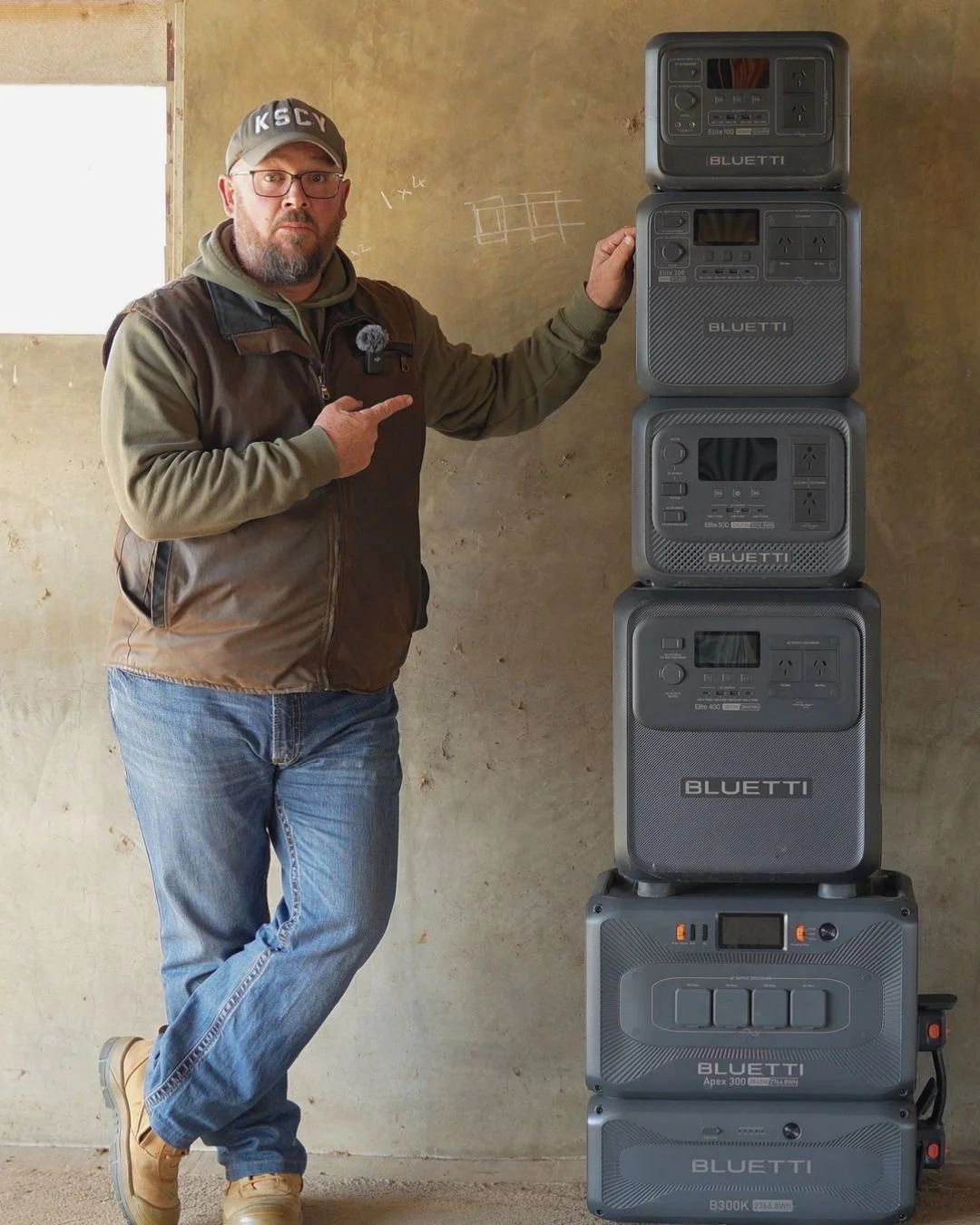
How Much Camping Power Do You Really Need?
Whether you're running a camping fridge, charging a few devices or powering an entire campsite, choosing the right power station can be confusing.
I've built this free calculator to help you work out how much battery storage, power output and charging capacity you actually need.
Just enter your appliances, how long you're going away and whether you'll be charging from solar or your vehicle.
The calculator will give you the numbers you need to compare power stations from any brand, along with some suitable BLUETTI options.
The idea is simple: buy what you need, not just what someone is trying to sell you.
How much camping power do you actually need?
Choose what you run, how long you're away, and whether you can recharge. We'll suggest the smallest suitable current BLUETTI power station, with editable real-world assumptions.
1. What are you powering?
Editable estimatesW = watts while running. Hours = time switched on each day. Duty % = percentage of that time drawing the listed watts. Example: a compressor fridge may run 40% of the day, not continuously.
2. Your trip
3. Can you recharge while camping?
4. Your power requirements
5. Your minimum power station requirements
Use these figures to compare power stations from any brand. Estimates are based on the appliances, trip length and charging options you selected.
Charging estimates depend on weather, shade, driving time and your equipment. Check the power station’s charging limits and connections before buying.
6. BLUETTI recommendations
Models must have sufficient stored energy throughout the trip and enough continuous AC wattage for a conservative simultaneous-use check. Daily charging is applied to the battery after that day's consumption. The first suitable model shown is the smallest in this list that meets the estimates, not necessarily the best-value purchase. Larger stations may be discounted at similar prices.
Calculation assumptions and limitations
AC devices: 85% energy efficiency, plus 8W estimated inverter idle draw for hours the AC inverter is on. DC and USB loads: 93% energy efficiency. These are planning assumptions, not manufacturer guarantees. Brand-neutral minimum storage assumes the entered recharge energy is accepted without model-specific charging caps; individual power stations can require more capacity. The AC standby time is approximated using the longest daily AC appliance schedule, not the sum of appliance durations.
Daily energy = Σ(watts × hours × duty fraction ÷ output efficiency) + estimated inverter idle energy. Battery is simulated day by day. Solar harvest = panel W × equivalent full-sun hours × 0.75. Effective vehicle charging assumes 85% of configured nominal charge power, limited by the selected station's provisional combined DC charge ceiling. Where solar and vehicle charging occur in one day, the model conservatively limits their combined daily total using that ceiling and the larger of sun-equivalent hours or driving hours. This is approximate and not a guarantee of supported connections or simultaneous charging.
The compressor duty cycle is an average energy approximation. Heater startup surges, ambient-temperature effects, charger conversion curves, low-load inverter efficiency and vehicle alternator capabilities aren't modelled. Simultaneous output is a conservative screen, not a detailed minute-by-minute schedule. You should check the model's ports, solar voltage limits and surge ratings before buying. All charger input ceilings are provisional, especially the Elite 10 Mini and AC2A, and should be checked against the exact model documentation before publishing recommendations commercially.
Explore BLUETTI Power Stations
Affiliate link: Have a Crack may earn a commission if you buy through this link, at no additional cost to you.